

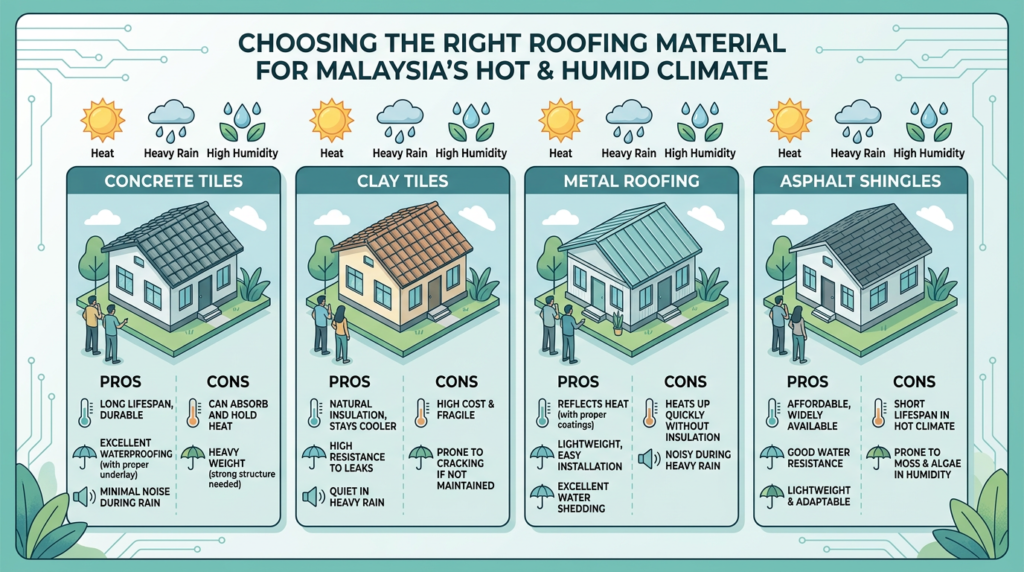
Malaysia’s tropical weather is hot, humid, and rainy almost all year round, so your roofing material has to handle strong sun, heavy rain, and high moisture. Choosing the right roof affects indoor temperature, noise during storms, maintenance cost, and how long your house stays leak‑free.
Key Things to Consider First
Before looking at materials, think about:
Climate stress: High UV, 75–90% humidity, and over 2,500 mm of rain a year put constant stress on roofs.
Heat control: Light colours, reflective surfaces, and good insulation help keep interiors cooler.
Noise and comfort: Metal roofs can be noisy in heavy rain if not insulated, while tiles absorb more sound.
Roof design: Steep pitched roofs with proper overhangs shed rain faster and protect walls better.
Common Roofing Options in Malaysia
1. Concrete Roof Tiles
Concrete tiles are one of the most popular choices for landed homes in Malaysia.
Pros
Durable, fire‑resistant, and widely available.
Good thermal mass, helps reduce direct heat transfer when combined with underlay.
Many colours and profiles to match terrace, semi‑D, and bungalow designs.
Cons
Heavier than other systems; roof structure must be designed for the load.
Cheaper tiles can fade, grow moss, and need periodic cleaning in humid weather.
Best for: Typical terrace houses and semi‑D roofs where aesthetics and long life are important.
2. Clay Roof Tiles
Clay tiles are traditional and common on premium homes and heritage buildings.
Pros
Very long lifespan, often 100+ years with proper installation.
Excellent natural thermal regulation; helps keep interiors cooler in daytime heat.
Colours baked into the tile and do not fade easily.
Cons
Usually more expensive than concrete tiles.
Requires careful installation and a proper supporting structure.
Best for: Premium homes, heritage designs, and owners who want a long‑term, low‑maintenance solution with good heat performance.
3. Metal Roofing (Steel / Aluminium)
Metal roofing (such as coated steel or aluminium sheets) is common on factories and some houses.
Pros
Lightweight, strong, and quick to install.
Coated metal resists rust and corrosion in humid, rainy conditions.
Reflects sunlight and cools quickly after rain, especially in light colours.
Cons
Can be noisy during heavy rain without proper insulation and ceiling.
Absorbs heat if dark‑coloured and not combined with reflective insulation.
Best for: Extensions, pergolas, car porches, and some modern houses where lightweight and fast installation are priorities, combined with good insulation.
4. Asphalt Shingles
Asphalt shingles are increasingly used on pitched roofs in Malaysia.
Pros
Good waterproofing performance and attractive appearance.
Flexible and easier to install on complex roof shapes.
Designed to handle strong sun and heavy rainfall typical of Malaysia’s climate.
Cons
May require proper plywood decking and underlay, increasing system cost.
Lifespan can be shorter than high‑quality tile roofs.
Best for: Homeowners who want a modern look, good waterproofing, and reasonable cost on steep pitched roofs.
5. Synthetic / Resin and Polycarbonate Systems (Special Areas)
Synthetic resin tiles, APVC sheets, and polycarbonate panels are used for certain roofs, awnings, and pergolas.
Pros
Some resin tiles and APVC sheets are designed to resist UV, moisture, and corrosion in hot, humid climates.
Polycarbonate panels provide full waterproofing and high light transmission while blocking UV.
Cons
Polycarbonate can trap heat and increase rain noise if not ventilated or tinted.
Quality varies; cheap products may yellow, crack, or leak over time.
Best for: Canopies, pergolas, and extensions where light transmission or lightweight roofing is important, not usually as the main house roof.
Don’t Forget Roof Insulation and Colour
Reflective insulation (like aluminium bubble foil) can reflect a high percentage of radiant heat, reducing indoor temperatures and AC usage.
Light‑coloured roofs reflect more sunlight and reduce heat gain compared to dark colours.
For Malaysia, a combination of a suitable roofing material plus good insulation and ventilation usually works better than material choice alone.
Simple Decision Guide for Homeowners
Want cooler interiors and classic look: Clay tiles with reflective underlay.
Balanced cost and performance: Concrete tiles with proper sarking and ventilation.
Lightweight and fast installation: Metal roof (light colour) plus good insulation to control heat and noise.
Modern look and waterproofing on complex roof shapes: Asphalt shingles with full underlay system.
By matching roof type to your house design, climate exposure, and budget—and adding proper insulation—you can achieve a comfortable, long‑lasting roof for Malaysia’s hot and humid weather.