

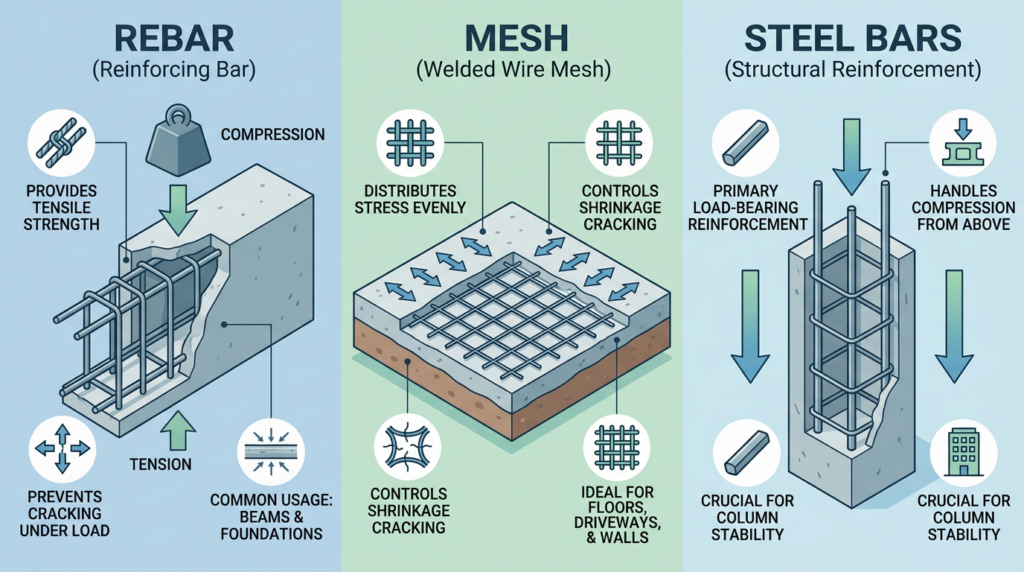
If you are planning or supervising a house construction project, you will often hear terms like “rebar”, “mesh”, and “steel bars”. These are all forms of steel reinforcement that help concrete carry loads safely and reduce cracking. This beginner-friendly guide explains what each one is, where it is used in a typical house, and how to talk to your contractor about them.
Why Concrete Needs Steel Reinforcement
Concrete is very strong in compression (being squeezed) but relatively weak in tension (being pulled or bent). When slabs, beams, and columns bend under load, the tension is taken by steel reinforcement so that the concrete doesn’t crack and fail. Steel bars and mesh work together with concrete to form “reinforced concrete”, which is the main structural system in most modern houses.
What Is Rebar?
Rebar (short for “reinforcing bar”) is a steel bar with a deformed (ribbed) surface that bonds strongly to concrete. The ribs help the bar “lock in” so it does not slip when the concrete is loaded.
Where Rebar Is Used in a House
Foundations and footings: Long bars run along the length of strip footings or pile caps to resist bending.
Beams and columns: Rebar cages (a framework of bars tied together) form the skeleton inside beams and columns.
Slabs and staircases: Bars are placed at the bottom or top of the slab (depending on where the tension is) to control cracking and deflection.
Typical rebar sizes for residential projects are in the range of 10–20 mm diameter, spaced according to structural design. The exact size and spacing must follow the engineer’s drawings and relevant standards.
What Is Reinforcement Mesh?
Reinforcement mesh is a grid of steel wires or small bars welded together into a mat. It is supplied in sheets or rolls and can be placed quickly over large areas of concrete.
Where Mesh Is Used in a House
Floor slabs on ground: Welded mesh is often used in ground slabs and house floors to reduce shrinkage cracks and distribute loads.
Driveways and patios: Mesh helps control cracking in thinner slabs that carry light vehicles or foot traffic.
Small slabs and toppings: It is convenient for bathrooms, kitchens, and balcony slabs where rebar grids would be slower to install.
Mesh is generally easier and faster to install than individual rebar, but it has lower tensile capacity than properly sized bars. For heavy loads or thick slabs, engineers often prefer rebar or a combination of rebar plus mesh.
What Are Steel Bars (Round Bars vs Deformed Bars)?
The term “steel bars” in house construction usually refers to reinforcing bars used in concrete. There are two common surface types:
Deformed bars: Have ribs or lugs; they bond strongly to concrete and are standard for structural reinforcement.
Plain round bars: Smooth surface; used for links, stirrups, and some non-structural applications where high bond is less critical.
In many markets, deformed bars are manufactured and certified to specific grades (for example, B500B or equivalent), which indicate yield strength and quality. Higher grade means the bar can take more stress before yielding, allowing more efficient designs.
Rebar vs Mesh: Which One for My House?
Both rebar and mesh improve concrete performance but are suited to different situations.
Use mainly rebar when:
You have beams, columns, and structural walls carrying significant loads.
Slabs are thicker or support heavy loads, such as car porches or suspended floors.
Use mesh (sometimes with additional bars) when:
You are reinforcing ground slabs, small floors, or light‑duty driveways.
The goal is mainly to reduce shrinkage cracks and distribute load, not to carry heavy structural loads.
Many houses use a combination: rebar cages in beams and columns, plus welded mesh in floor slabs and toppings.
Basic Terms You Should Know
When you read drawings or talk to your contractor, you may see these terms:
Diameter (e.g., Y10, Y12): The thickness of the bar in millimetres; larger numbers mean thicker bars.
Spacing (e.g., @200 mm): The distance between parallel bars or mesh wires.
Cover: The thickness of concrete between the reinforcement and the surface, which protects the steel from corrosion and fire.
Stirrups or links: Smaller bars wrapped around the main bars in beams and columns to hold them together and resist shear.
Understanding these simple terms already puts you ahead of most homeowners when reviewing reinforcement details.
How to Check Reinforcement on Site (For Beginners)
You do not need to be an engineer, but you can do a few basic checks before concreting:
Compare bar sizes and spacing with the structural drawings; if something looks obviously different, ask your engineer or supervisor.
Make sure mesh sheets overlap correctly (according to design) and are tied with wire so they do not move when workers walk on them.
Check that spacers or concrete blocks are used so rebar and mesh are lifted off the ground to achieve proper cover.
Ensure bars are clean from heavy rust, mud, or oil before concrete is placed.
These simple steps help ensure the strength and durability of your house structure.
Final Thoughts for Homeowners
Rebar, mesh, and steel bars are hidden inside the concrete, but they are critical for the safety of your home. By understanding the basic role of each type of reinforcement and asking the right questions, you can work more confidently with your engineer and contractor and avoid costly mistakes.