

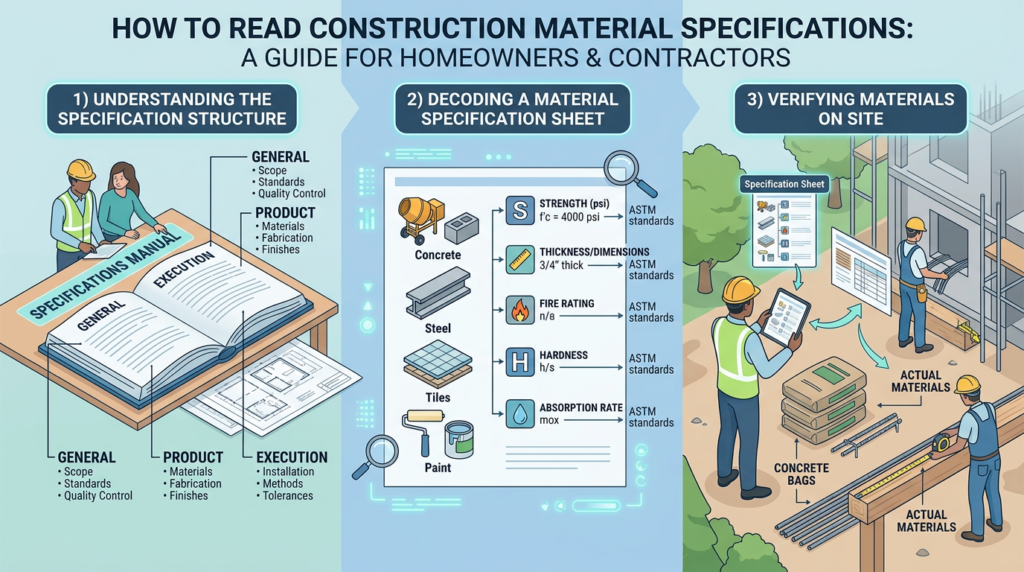
Material specifications are like the “recipe” for your building—they tell you exactly what materials to use, how good they must be, and how they should be installed. If you can read basic specs, you can check quotations, avoid cheap substitutions, and make sure your house is built to the standard you expect.
Where to Find Material Specifications
On most projects, material specs appear in:
The project manual or “spec book”, usually organised by divisions such as concrete, masonry, roofing, finishes, and so on.
Specification sheets or schedules attached to drawings (for example, a door schedule, finishes schedule, or roof specification).
Product datasheets from suppliers, which give technical details such as strength, thickness, coating, and standards.
As a homeowner or contractor, always ask for the specification section or schedule that matches the element you are discussing (concrete, tiles, roof, paint, etc.).
Basic Structure of a Specification Section
Many specs follow a three–part structure: General, Product, Execution.
General: Describes scope, related sections, and reference standards.
Product: Lists the exact materials to be used, including brand or performance requirements.
Execution: Explains how the material must be installed, tested, and finished on site.
When reading, focus first on the Product and Execution parts—this is where most of the practical information for materials and workmanship is found.
Key Items to Look For in Material Specs
When you open a spec or schedule, scan for these points:
Material type and description
Example: “Ready‑mix concrete, 30 MPa at 28 days” or “Clay brick, load‑bearing, minimum compressive strength 7 MPa”.
Performance or strength requirements
For concrete, look for compressive strength and exposure class.
For steel, look for grade (for example, yield strength) and coating or corrosion protection.
Dimensions and thickness
Tile size, roof sheet thickness, rebar diameter, or insulation thickness.
Standards and references
Look for phrases such as “in accordance with Malaysian Standard” or “comply with manufacturer’s instructions”.
Referenced standards define test methods and minimum quality levels.
Finishes and colours
Paint system (number of coats, type of primer), roof colour, or tile finish.
Execution notes
Requirements for surface preparation, curing, installation methods, and inspection/testing.
Highlight these items so you can easily compare them with contractor quotations and site practice.
Common Terms Homeowners Should Understand
Specifications often use technical terms that may look confusing at first. Here are a few you will see often:
“Minimum compressive strength”: The lowest allowable strength of concrete or masonry under compression.
“Yield strength” (for steel): The stress at which steel starts to deform permanently.
“R‑value” (for insulation): How well a material resists heat flow; higher values mean better insulation.
“Or equal”: The contractor may propose an alternative product, but it must meet or exceed the specified performance.
“By approved manufacturer”: The product must come from a supplier accepted by the architect/engineer.
Knowing these basic terms makes it easier to ask questions and challenge unclear proposals.
How Homeowners and Contractors Can Use Specs Day-to-Day
For homeowners:
When you receive a quotation, check whether the listed materials match the specification (for example, same grade of concrete, same tile type, same roof material).
If a contractor suggests a cheaper alternative, ask for the product datasheet and confirm that strength, thickness, and standards are the same or better.
For contractors:
Read the relevant sections (product and execution) before ordering materials or starting work.
Mark up drawings with spec references so your team knows which material is required at each location.
When in doubt or when specs and drawings conflict, request clarification from the architect or engineer before proceeding.
By treating specifications as a working document—not just paperwork—you can reduce disputes, avoid rework, and get a building that performs as intended.