

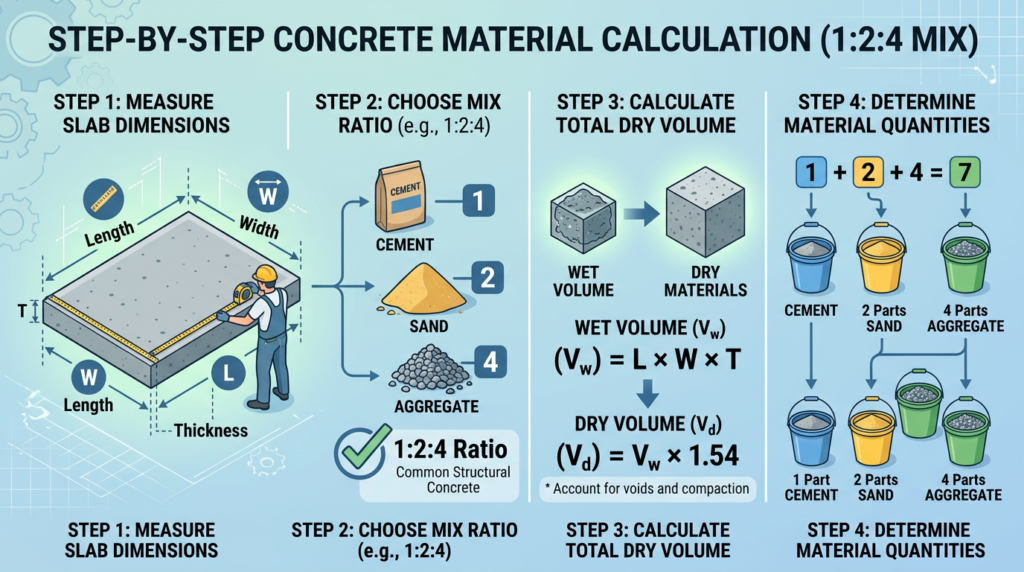
For small projects like house slabs, driveways, or beams, many contractors still use simple volume-based mix ratios such as 1:2:4. This guide walks you through a clear, step‑by‑step method to estimate how much cement, sand, and aggregate you need, using the common dry‑volume approach.
Step 1: Determine the Volume of Concrete
First, calculate the total wet volume of concrete required.
Formula:
Volume = Length × Width × Thickness
Example:
Slab size = 4 m (L) × 3 m (W)
Thickness = 0.15 m
Volume = 4 × 3 × 0.15 = 1.8 m³ (wet concrete)
Step 2: Choose the Concrete Mix Ratio
For many general residential slabs and beams, a common nominal mix is 1:2:4 (Cement : Sand : Aggregate).
1 part cement
2 parts sand (fine aggregate)
4 parts gravel or crushed stone (coarse aggregate)
This mix is often used for medium‑strength concrete in small building projects.
Total parts = 1 + 2 + 4 = 7 parts.
Step 3: Convert Wet Volume to Dry Volume
When you batch materials by volume, you need extra volume to account for voids, bulking, and wastage. A common factor is 1.54.
Dry Volume = Wet Volume × 1.54
For our example slab:
Dry Volume = 1.8 m³ × 1.54 ≈ 2.77 m³
Step 4: Calculate Volumes of Cement, Sand, and Aggregate
Now distribute the dry volume according to the mix ratio.
Cement volume = (1 ÷ 7) × 2.77 ≈ 0.40 m³
Sand volume = (2 ÷ 7) × 2.77 ≈ 0.79 m³
Aggregate volume = (4 ÷ 7) × 2.77 ≈ 1.58 m³
You can round slightly for site practicality.
Step 5: Convert Cement Volume to Number of Bags
To estimate bags of cement, assume 1 m³ of cement ≈ 1440 kg.
For 50 kg bags:
Cement mass = 0.40 m³ × 1440 kg/m³ ≈ 576 kg
Number of bags = 576 ÷ 50 ≈ 11.5 → about 12 bags of cement.
Step 6: Summary for the Example Slab
For a 4 m × 3 m × 0.15 m concrete slab using a 1:2:4 mix, you will need approximately:
Cement: about 12 bags of 50 kg
Sand: about 0.79 m³
Aggregate: about 1.58 m³
You should add a small allowance (for example 5–10%) for site wastage and uneven ground levels.
Notes and Good Practices
These calculations are for nominal mixes and small projects; structural elements in bigger projects should follow an engineer’s mix design.
Keep units consistent (all dimensions in metres when calculating volume).
Do not forget water and workability; typical water–cement ratios for small projects are around 0.4–0.5 by mass.
By following these basic steps, homeowners and small contractors can plan material orders more accurately and avoid shortage or excessive leftover materials on site.