

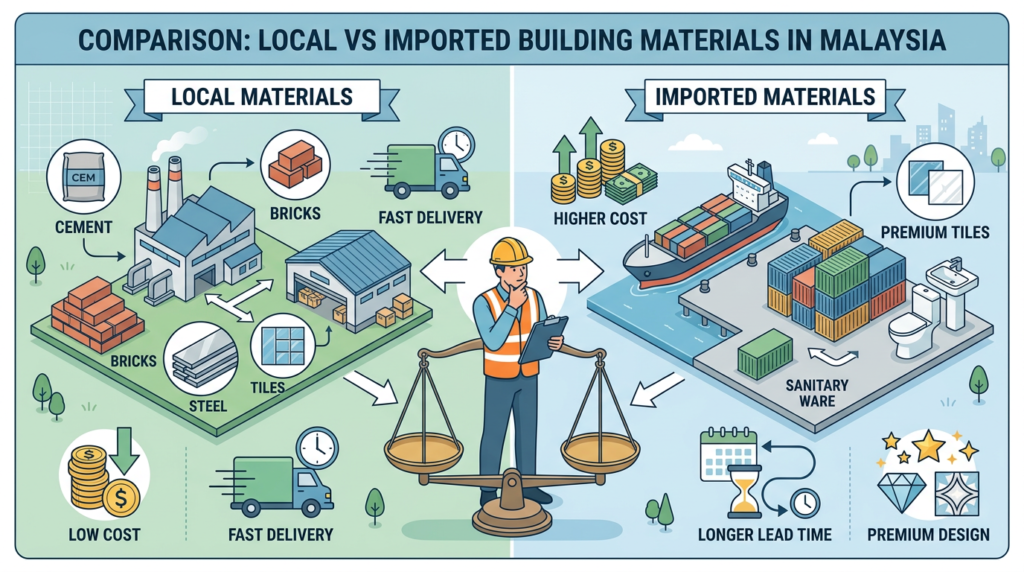
Contractors and homeowners in Malaysia often struggle to decide whether to use locally produced or imported building materials. Both options can work well, but they differ in cost, delivery time, design options, and regulatory requirements.
What Do “Local” and “Imported” Mean in Malaysia?
Local materials: Products manufactured in Malaysia, such as many cement brands, steel reinforcement, concrete products, and some tiles and roofing systems.
Imported materials: Products brought in from other countries, often Europe or Asia, including premium tiles, sanitary ware, glass systems, and some specialist roofing or bitumen products.
Both local and imported materials must comply with Malaysian Standards and CIDB requirements when they fall under regulated categories.
Pros and Cons: Local vs Imported Materials
| Factor | Local Materials | Imported Materials |
|---|---|---|
| Cost | Usually lower due to shorter transport and no import duty/shipping; better for tight budgets. | Often higher because of freight, insurance, and customs duties; can increase project cost. |
| Delivery time | Faster and more flexible; easier to top up orders or replace damaged items. | Longer lead times; risk of shipping delays, customs clearance issues, or supply disruptions. |
| Quality & suitability | Can be very good, especially from established Malaysian manufacturers familiar with local climate and usage. | Often associated with consistent factory quality and advanced technology, especially for specialist systems or high‑end finishes. |
| Availability & replacement | Easier to find matching stock later (for tiles, roof tiles, etc.), useful for repairs and extensions. | Matching exact shade or batch can be difficult; may require re‑ordering from overseas with minimum quantities. |
| Design & branding | Limited for some finishes but improving; good value basic and mid‑range options. | Wider variety of designs, formats, and premium brands, especially for tiles, sanitary ware, glass, and façade systems. |
| Environmental impact | Lower shipping emissions and often easier to audit supply chain. | Higher carbon footprint from sea/air freight unless offset; sometimes stricter origin-country standards. |
In short, local materials usually win on cost, speed, and ease of replacement, while imported materials are chosen for specific looks, technology, or brand requirements.
Cost Considerations in the Malaysian Context
Transport and duties: Imported materials carry extra costs such as ocean freight, insurance, import tariffs, and sometimes safeguard duties on items like steel.
Policy changes: The government has signalled that it may relax some import conditions when needed to keep construction costs under control, especially for housing.
Market competition: Authorities also monitor the import of substandard materials, and certain products require Certificates of Approval to enter Malaysia.
For many residential projects, local cement, aggregates, bricks, and reinforcement remain the most cost‑effective, while imported choices are usually reserved for finishes (tiles, sanitary ware, specialized roofing).
Where Local Materials Often Make More Sense
You typically gain more by going local when your priorities are affordability, speed, and easy maintenance:
Structural materials: Locally produced cement, ready‑mix concrete, steel bars, and aggregates are widely available, easier to test, and generally cheaper.
Standard tiles and roofing: Local tiles and roof systems are designed for Malaysia’s heat and humidity, and replacements are easier to source later.
Bulk orders for housing projects: Shorter lead times and lower shipping risk make local sourcing more practical for repetitive items.
Experts note that local materials can be as good as, or better than, imported options depending on the supplier and quality control.
When Imported Materials Are Worth Considering
Imported materials are most useful when you need:
High‑end or specialised design: Premium European or Japanese tiles, façade systems, or sanitary ware with unique textures, colours, or technology.
Proven technology for specific applications: Certain waterproofing systems, bitumen products, or advanced glazing solutions may be imported for performance reasons.
Strict project requirements: Some international or flagship projects specify particular brands or certifications that are only available from overseas.
The decision should weigh lifecycle cost, maintenance, and availability of spare parts—not just initial purchase price.
Practical Checklist for Homeowners and Contractors
When choosing between local and imported building materials in Malaysia:
Clarify priorities: Decide whether you are optimising for cost, speed, aesthetics, or long‑term performance.
Confirm standards and CIDB compliance: Whether local or imported, regulated materials must meet Malaysian Standards and have proper certification.
Compare total cost: Include transport, duties, potential delays, and wastage in your cost comparison—not just the catalogue price.
Think about replacement and maintenance: For tiles, roofing, and façade elements, ensure you can source matching items later if repairs are needed.
Mix and match smartly: Many Malaysian projects use local materials for structure and most finishes, adding imported items selectively where they add real value.
By making informed choices, you can balance affordability and quality while supporting both local industry and the specific performance needs of your project.