
When you renovate or build a house in Malaysia, you are not just choosing “any” cement, tiles, or steel. Certain building materials are regulated by CIDB (Lembaga Pembangunan Industri Pembinaan Malaysia) and must comply with Malaysian Standards before they can legally be used on site. Understanding the basics will help you avoid sub‑standard products and problems during inspection or loan approval.
Why CIDB Regulates Building Materials
CIDB enforces parts of Akta 520 to make sure key construction materials meet minimum safety and quality standards.
Under the Act, selected construction materials must comply with specific Malaysian Standards or other approved standards before they can be sold or used.
The goal is to prevent the use of low‑quality products that can cause structural failures, leaks, or premature deterioration.
Non‑compliance is an offence: using regulated materials without proper certification can result in fines between RM10,000 and RM500,000.
For homeowners, this means you should insist that key materials on your project are CIDB‑compliant and properly certified.
Which Building Materials Are Covered? (Fourth Schedule)
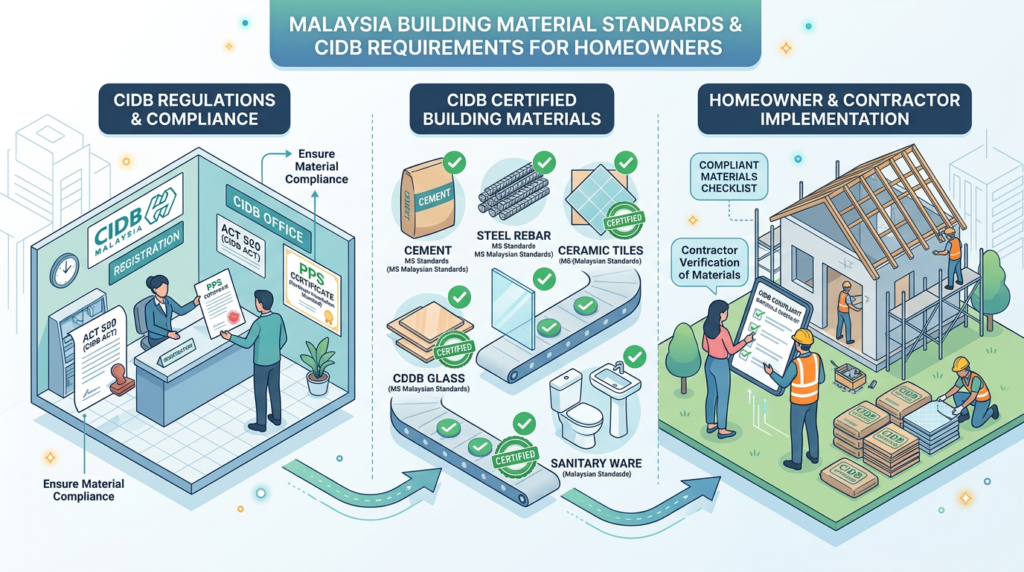
CIDB lists regulated construction materials in the Fourth Schedule of Act 520. These products must have a valid Perakuan Pematuhan Standard (PPS)—Certificate of Standards Compliance—before they can be used.
The 13 main categories currently include:
Aluminium
Insulation materials (including radiant barrier / thermal foil)
Ceramic tiles
Glass (construction glass)
Fibre cement flat sheets (non‑asbestos)
Precast concrete products
Ready‑mix concrete
Cement
Industrialised Building System (IBS) components
Ceramic pipes and fittings
Sanitary ware
Iron and steel products (rebar, beams, mesh, etc.)
Radiant barrier / thermal insulation foil
If your renovation involves any of these materials—which most housing projects do—you should check that your contractor uses products with valid CIDB certification.
What Is PPS and How Do You Recognise It?
PPS (Perakuan Pematuhan Standard) is CIDB’s Certificate of Standards Compliance issued to manufacturers and importers whose products meet the required standards.
Only materials listed in the Fourth Schedule and holding a valid PPS can legally be used in Malaysian construction projects.
Manufacturers must go through testing and audits with accredited certification bodies (such as CIDB Holdings) to obtain PPS.
As a homeowner, you can:
Ask your contractor or supplier for proof of PPS or a standards‑compliance certificate for key materials like rebar, ready‑mix concrete, tiles, glass, and sanitary ware.
Refer to CIDB’s Daftar Bahan Binaan (Register of Certified Construction Materials), which lists brands and products that have been certified.
What Homeowners Should Check in Quotations and On Site
Even if you are not a technical person, you can do a few simple checks:
Brand and product name
Ensure the quotation states the brand or at least mentions “CIDB‑certified” for regulated materials like tiles, cement, and rebar.
Standard references
Look for references such as MS EN 197 for cement, or other Malaysian Standards listed in CIDB’s construction materials page and Daftar Bahan Binaan.
PPS or equivalent documentation
Ask the supplier to show PPS certificates or labels for bulk materials (iron and steel, precast concrete, radiant barrier, etc.).
Contractor’s responsibility
CIDB’s contractor registration guidelines state that contractors must ensure products used comply with MS or other approved standards and are certified by CIDB.
By asking these questions early, you push your contractor to plan for compliant materials from the beginning, rather than switch later to cheaper, uncertified products.
How This Affects You as a Homeowner
Choosing CIDB‑compliant materials is not just about avoiding fines; it also affects safety, durability, and property value.
Safer and more durable homes: Certified cement, steel, tiles, and glass have been tested for strength, fire resistance, and performance.
Fewer future problems: Using recognised materials lowers the risk of structural defects, leaks, and premature failures that are expensive to fix.
Better documentation: Having invoices and certificates for key materials can help if you sell the house, make an insurance claim, or face disputes over workmanship quality.
In short, when planning renovation or new construction in Malaysia, you should treat CIDB material standards and PPS certification as a basic requirement, not an optional extra.