

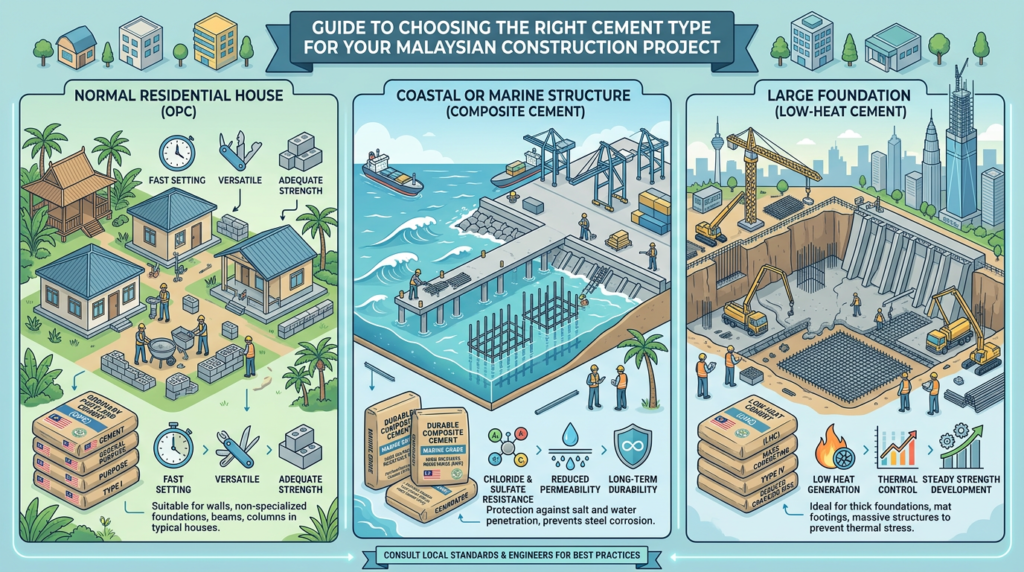
Choosing the right cement type is very important for the strength, durability, and cost of any construction project in Malaysia. Different projects—like terrace houses, high-rise buildings, coastal structures, or decorative works—may require different cement properties. This guide explains the main cement options available in the Malaysian market and gives you a simple checklist to decide which one fits your project.
Cement Standards and Types in Malaysia
In Malaysia, common cements must comply with the Malaysian Standard MS EN 197-1, which groups cement into several main types such as Portland cement, Portland-composite cement, blast furnace cement, and others.
For bagged cement sold at hardware shops, the three most common categories are: Ordinary Portland Cement (OPC), Portland Composite Cement (PCC or Portland-limestone cement), and masonry cement.
Each cement also has a strength class such as 32.5, 42.5, or 52.5, and a letter for early strength (N for normal, R for rapid, and sometimes L for low early strength).
In simple terms, the higher the strength class, the higher the potential compressive strength of the concrete if properly designed and cured..
Main Cement Types You Will See
1. Ordinary Portland Cement (OPC)
OPC is the most widely used general-purpose cement, suitable for most structural concrete works such as beams, slabs, columns, and foundations.
It develops strength relatively quickly and is commonly used in high-rise buildings, bridges, pavements, and precast elements where reliable performance is required.
When to consider OPC:
Structural concrete for houses, apartments, offices, and commercial buildings.
Projects that need faster strength gain and early formwork removal, within normal temperature conditions.
2. Portland Composite Cement / Portland-Limestone Cement (PCC)
Portland composite cements are produced by blending Portland cement clinker with other materials such as limestone, fly ash, or slag.
These cements can improve workability, reduce heat of hydration, and lower the overall carbon footprint compared to pure OPC.
When to consider PCC:
General building work where slightly slower strength gain is acceptable.
Mass concrete elements or hot climates where lower heat development is beneficial.
Projects that prioritise sustainability and reduced CO₂ emissions.
3. Rapid Hardening Cement
Rapid hardening cement is formulated to achieve higher early strength in a shorter time than normal OPC.
It generates more heat and is often used where early loading or quick turnover is needed.
When to consider rapid hardening cement:
Urgent repairs, road works, or precast elements that must reach strength quickly.
Situations where formwork needs to be stripped early to speed up construction.
4. Sulphate-Resisting and Low-Heat Cements (Project-Specific)
Some specialised projects may require sulphate-resisting cement or low-heat cement, which are usually specified by the engineer.
Sulphate-resisting cement is used where soil or groundwater has high sulphate content, while low-heat cement is used for very large pours to reduce cracking from heat build-up.
Step-by-Step: How to Choose the Right Cement
Step 1: Look at Your Project Type and Location
Normal residential house or small commercial building
For standard reinforced concrete elements in typical soil conditions, OPC or good-quality Portland composite cement with suitable strength class is usually sufficient.Coastal, marine, or aggressive soil environments
Where structures are exposed to seawater, groundwater, or chemicals, the designer may specify a particular cement type or concrete class with better durability and resistance to sulphates or chlorides.Large mass concrete or hot weather concreting
For thick raft foundations, retaining walls, or dams, lower-heat cement or composite cement, combined with a suitable mix design, can help control temperature rise and cracking.
Step 2: Check the Strength Class on the Bag
On the cement bag, you will usually see something like “CEM I 42.5 R” or “CEM II/B-L 32.5 N”.
32.5: Suitable for general non-critical work where slower strength gain is acceptable.
42.5: Commonly used for structural concrete in buildings.
52.5: Used for high-strength or special applications where very high performance is needed.
For most building projects, 42.5 N or 42.5 R is a practical and commonly specified class.
Step 3: Consider Early Strength Needs
Ask yourself: does the project need very fast early strength for formwork removal or traffic opening?
If yes, a higher early strength class (marked R) or rapid hardening cement may be suitable, combined with proper curing.
If no, normal early strength (N) is usually enough and can help reduce cracking risk in some situations.
Step 4: Think About Durability and Environment
Different cement types affect the concrete’s resistance to aggressive environments, permeability, and long-term durability.
Projects exposed to seawater, industrial chemicals, or constant moisture often need a mix designed for durability, which may include composite or specialised cements and lower water–cement ratios.
Step 5: Confirm with Your Structural Engineer or Supplier
Always cross-check cement type and strength class with:
Structural drawings and specifications.
Recommendations from your engineer or qualified consultant.
Technical data sheets from the cement manufacturer or supplier.
This ensures that the cement you purchase matches the design assumptions used for your building’s structural safety.
Practical Tips When Buying Cement in Malaysia
Buy from reputable brands and suppliers that clearly show MS EN 197-1 compliance on the bag.
Check the manufacturing date and avoid very old stock that may have absorbed moisture and lost performance.
Store bags in a dry, ventilated area, stacked off the floor and away from walls.
Do not mix different cement types in the same structural element unless approved in the design and properly tested.
Simple Rule of Thumb
For normal residential and many commercial projects: a good-quality OPC or Portland-composite cement of class 42.5 N or 42.5 R, used with a proper concrete mix design, is usually suitable.
For special conditions (coastal, chemical exposure, very thick elements, or very fast construction): follow the specific cement and concrete requirements given by your engineer and the project specifications.
By paying attention to project type, environment, strength class, and standards, you can choose the right cement type and avoid costly problems such as cracking, low strength, and durability issues later on.