

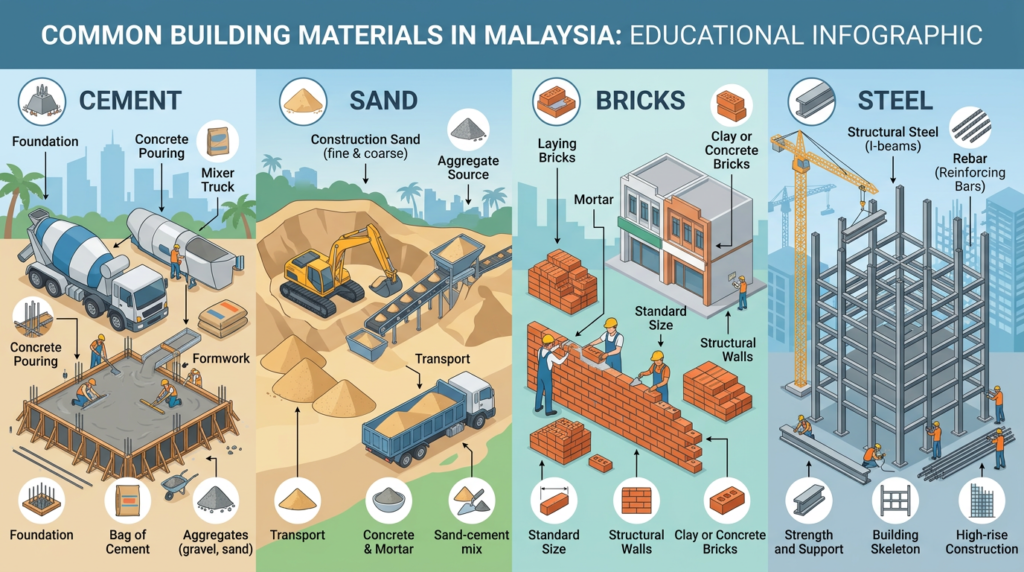
Building a house or commercial project in Malaysia starts with understanding the basic building materials used on almost every site. This guide explains the key materials—cement, sand, bricks, and steel—so that homeowners, students, and new contractors can better understand what they are paying for and how each material affects quality, cost, and durability.
Why These Materials Matter in Malaysia
In Malaysia’s hot, humid, and rainy climate, building materials must withstand moisture, heat, and occasional extreme weather. Concrete, masonry, and steel are therefore the backbone of most residential and commercial projects.heidelbergmaterials+1
Cement, sand, bricks, and steel are also the core items monitored in market and cost reviews because they make up a large portion of total construction cost.mycc+1
Cement
What Is Cement?
Cement is a fine grey powder made from materials such as limestone and clay, which hardens when mixed with water. It acts as a binder that holds sand, aggregates, and bricks together in concrete and mortar.odysseynow+1
In Malaysia, ordinary Portland cement and other hydraulic cements must comply with Malaysian Standards such as MS EN 197 and related CIDB requirements.cidb+1
Common Uses of Cement in Malaysia
Concrete: Foundations, slabs, beams, columns, and structural elements.aathaworld+1
Mortar: Bricklaying and blockwork for walls and partitions.odysseynow
Plastering and screeding: Wall finishes, floor screeds, and repair works.odysseynow
You can remind readers that cement is never used alone; it is always mixed with water, sand, and aggregates to form concrete or mortar.odysseynow
Tips When Choosing Cement
Check for certification marks or standards listed on the bag (e.g., MS EN 197) to ensure quality.cidb+1
Store bags in a dry place, raised off the floor, and use older stock first to avoid lumps and loss of strength.odysseynow
For structural works, follow the mix design or engineer’s specifications instead of “agak-agak” ratios.scribd
Sand
Role of Sand in Construction
Sand is a fine aggregate used in concrete, mortar, plaster, and as a leveling layer for brick and paving works. It helps fill gaps between coarse aggregates and binds with cement to form a dense, strong mix.heidelbergmaterials+1
Types of Sand Commonly Used in Malaysia
Coarse sand: Used for concrete and structural works.mybuildingmaterial
Fine sand: Used for plastering and finishing.mybuildingmaterial
River sand or quarry sand: Depending on availability and local regulations.scribd+1
What to Look Out For
Cleanliness: Excessive silt, clay, or organic matter can weaken concrete and mortar.heidelbergmaterials+1
Grading: Well-graded sand helps achieve better workability and strength.heidelbergmaterials
Source and legality: Use sand from approved sources to comply with local regulations and environmental guidelines.cidb+1
Bricks
Common Brick Types in Malaysia
Bricks are one of the most popular walling materials in Malaysia due to their strength, durability, and good fire resistance.aathaworld+1
Typical brick types include:
Clay bricks: Traditional red bricks, strong and durable, with good thermal performance.hub.unitrade+1
Cement bricks: Made from cement and aggregates, commonly used for cost-effective walling.hub.unitrade+1
Facing bricks: Higher-quality bricks used where the brick surface is exposed for aesthetic purposes.hub.unitrade
Where Bricks Are Used
External and internal walls for houses and low-rise buildings.aathaworld+1
Boundary walls, retaining walls (with structural design), and decorative walls.odysseynow
Fire-rated walls in certain commercial and industrial applications.aathaworld
Choosing Bricks for Your Project
Check for uniform size, shape, and colour to reduce wastage during construction.hub.unitrade
Look at compressive strength and water absorption for load-bearing and external walls.hub.unitrade+1
For aesthetic facades, consider facing bricks or better-quality clay bricks.hub.unitrade
Steel
Why Steel Is So Important
Steel is widely used in Malaysian construction because it has very high tensile strength and works very well together with concrete, which is strong in compression.heidelbergmaterials+1
Reinforcing steel bars (rebar) form the “skeleton” of reinforced concrete structures, while structural steel sections are used in frames, roofs, and industrial buildings.scribd+1
Types of Steel in Typical Projects
Reinforcing bars (rebar): Used in slabs, beams, columns, and foundations to resist tension.scribd+1
Steel mesh: Used for slabs, driveways, and floor toppings.mybuildingmaterial+1
Structural steel sections: Beams, columns, and trusses in factories, warehouses, and some commercial buildings.aathaworld+1
Key Considerations for Steel
Compliance: Rebar and steel products should follow relevant Malaysian Standards and appear in CIDB’s recognised materials list where applicable.cidb+1
Corrosion protection: Proper concrete cover, coatings, or galvanizing help protect steel from rust, especially in coastal or wet environments.heidelbergmaterials+1
Handling and storage: Store steel off the ground and away from standing water to reduce rust before installation.scribd
How These Materials Work Together
Most Malaysian homes and buildings use a combination of these materials:
Cement and sand form mortar for laying bricks and plastering walls.aathaworld+1
Cement, sand, aggregates, and rebar combine to produce reinforced concrete for slabs, beams, columns, and foundations.scribd+1
Bricks create the wall system, while steel provides the structural frame and reinforcement.heidelbergmaterials+1
By understanding the basics of cement, sand, bricks, and steel, owners and new contractors can ask better questions, compare material options more confidently, and ensure that their projects in Malaysia use safe, durable, and cost-effective building materials.