

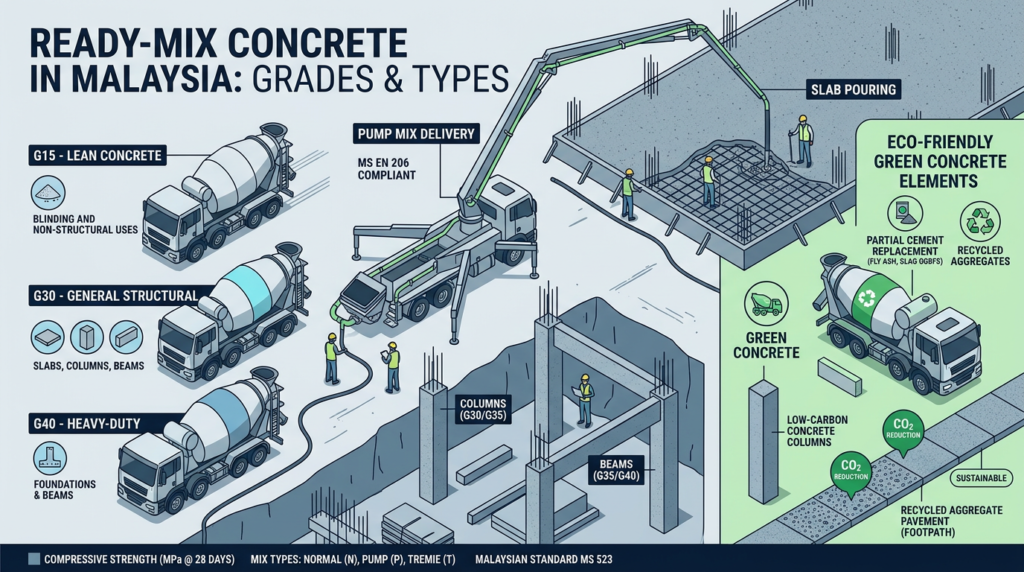
Ready-mix concrete is one of the most important building materials used in construction projects throughout Malaysia. It is popular among contractors and homeowners because it offers consistent quality, saves time on site, and reduces material wastage. In this guide, we explain what ready-mix concrete is, the common types and grades used in Malaysia, typical applications, and a price overview for 2026 so you can plan your project budget more accurately.
What Is Ready-Mix Concrete?
Ready-mix concrete (RMC) is concrete that is batched and mixed in a central plant according to a specific design mix, then transported to the site using a transit mixer truck. Instead of mixing sand, aggregate, cement, and water manually on site, all materials are measured and mixed under controlled conditions before delivery.
Because the mixing process is done at a dedicated plant, ready-mix concrete offers more consistent strength, workability, and durability compared to traditional site-mixed concrete. It also helps reduce human error, saves labour time, and minimizes wastage of materials at site.
In Malaysia, ready-mix concrete is widely used for residential houses, commercial buildings, infrastructure projects, and industrial facilities.
Common Types and Grades of Ready-Mix Concrete in Malaysia
In Malaysia, ready-mix concrete is usually specified by its characteristic compressive strength, measured in megapascals (MPa). You will commonly see grades such as G20, G25, G30, G35, and G40 in drawings, specifications, and supplier quotations.
Below is a simple overview of common grades and typical uses (values are approximate and for general guidance only):
| Grade | Approx. Strength (MPa) | Typical Use in Malaysia |
|---|---|---|
| G20–G25 | About 20–25 MPa | Light structural work, non-critical slabs and beams, minor RC elements |
| G30 | About 30 MPa | Standard house slabs, beams, columns, car porch slabs, driveways |
| G35–G40 | About 35–40 MPa | Heavier load slabs, multi-storey columns and beams, commercial buildings |
You can also describe types of ready-mix concrete based on application and workability:
Normal-strength ready-mix concrete
Suitable for typical residential and commercial structures. These mixes are designed for general structural use and are the most commonly ordered.High-strength ready-mix concrete
Used for heavily loaded elements such as high-rise building cores, long-span beams, and special structural components that require higher compressive strength.Pump mix vs. non-pump mix
Pump mix has higher workability (higher slump) so it can be pumped through concrete pumps to higher floors or difficult-to-reach areas. Non-pump mix is used where concrete can be discharged directly from the truck.Low-carbon or green concrete
Some suppliers now offer eco-friendly or low-carbon mixes that partially replace ordinary Portland cement with alternative materials to reduce CO₂ emissions. These mixes support green building certifications and sustainability goals.
Typical Uses of Ready-Mix Concrete
Ready-mix concrete is used in almost every type of construction project. You can structure the uses by project category:
1. Residential Projects
For house owners and small contractors, ready-mix concrete is commonly used for:
Foundations and pad footings
Ground beams and strip footings
Ground floor and first floor slabs
Columns and beams for terrace houses, semi-D, and bungalows
Car porch and driveway slabs
Retaining walls and boundary walls
Grades like G25 and G30 are frequently specified for these elements, depending on the structural design and soil conditions.
2. Commercial and Industrial Buildings
In commercial projects, ready-mix concrete is used for:
Multi-storey columns and beams
Flat slabs and post-tensioned slabs
Car park slabs and ramps
Industrial factory floors and heavy-duty yards
Here, higher grades such as G30, G35, or G40 are often used to handle higher loads and traffic.
3. Infrastructure and Large Projects
For infrastructure works, ready-mix concrete is used in:
Bridges and flyovers
Elevated highways and viaducts
Airport runways and taxiways
Port structures and retaining structures
These projects sometimes require special high-strength or durability-focused mixes, depending on design specifications and exposure conditions.
Price Guide for Ready-Mix Concrete in Malaysia 2026
Ready-mix concrete prices in Malaysia can vary depending on grade, location, supplier, raw material costs, and market conditions. For 2026, you should treat any figures as a general guide only and always confirm with suppliers for current quotations.
When discussing price in your blog post, you can break it down into the following components:
1. Base Price per m³
Ready-mix concrete is usually quoted per cubic metre (m³). The base price will depend on:
Grade (G20, G25, G30, G35, G40, etc.)
Type of mix (pump mix vs non-pump mix)
Aggregate type (granite, limestone, etc.)
Region (Klang Valley, northern region, southern region, East Malaysia, and so on)
As a general example for early 2026, many reference price lists and QS guides indicate that normal ready-mix concrete for common grades can fall in a typical range of a few hundred Ringgit per cubic metre. To keep your article evergreen and compliant, avoid locking in a fixed number; instead, explain that prices fluctuate with cement, fuel, and labour costs and advise readers to get updated quotations from local suppliers.
You can write something like:
“Based on recent cost indexes and QS references, typical ready-mix concrete prices in Malaysia in 2026 generally fall within a few hundred Ringgit per cubic metre for common grades such as G25 and G30. Actual prices will depend on location, project size, and supplier terms.”
2. Additional Costs and Surcharges
Besides the base price per m³, contractors and owners should also consider:
Pumping charges
If a concrete pump is required, there is usually a fixed pump fee plus an additional charge per m³ pumped. Some suppliers include a minimum volume for pump usage.Transport and distance charges
Suppliers generally include delivery within a certain distance from the plant. If your site is further away, there may be a per-kilometre surcharge or zone-based charge.Waiting time and extra trips
If the truck is held on site longer than the allowed free waiting time, or if additional small-volume trips are required, extra charges can apply.Market fluctuation and fuel surcharges
Concrete prices can increase when raw material and fuel prices go up. There may also be adjustments due to changes in government regulations, logistics costs, or sudden market demand.
In your blog post, remind readers always to confirm what is included in the quotation (grade, slump, cube test, number of trips, pump, GST/SST, etc.) before placing an order.
Factors to Consider When Choosing Ready-Mix Concrete
When selecting ready-mix concrete for a project, both homeowners and contractors should look at more than just the cheapest price. Key considerations include:
Structural design requirements
Always follow the structural engineer’s specified grade, slump, and any special durability requirements. Never downgrade the grade just to save cost without proper approval.Supplier reputation and quality control
Choose suppliers that follow Malaysian Standards (such as MS EN 206 or equivalent) and have proper batching control, cube testing, and quality records.Delivery reliability
For large pours or critical elements like slabs and columns, on-time delivery is crucial to avoid cold joints and delays on site.Workability and placement method
Confirm whether you need pump mix or normal mix, and inform the supplier about site conditions (height, access, pour sequence).Environmental and green building requirements
If your project aims for green certification or reduced carbon footprint, ask about low-carbon or eco-friendly concrete options.
How to Choose the Right Grade and Supplier
You can close your article with a practical checklist for readers:
Get your structural drawings and specifications checked by a qualified engineer to confirm the required concrete grade and slump.
Request quotations from at least two or three ready-mix suppliers in your area, using the same grade and volume for accurate comparison.
Ask what is included in the price: cube test, pump charges, transport distance, waiting time, and any surcharges.
Check whether the supplier complies with relevant Malaysian Standards and has experience with similar projects.
For large or important pours, schedule the delivery early and coordinate closely between the supplier, contractor, and pump operator.
Final Thoughts
Ready-mix concrete is a critical material for construction projects in Malaysia, and understanding the basics of grades, uses, and pricing will help homeowners and contractors make better decisions in 2026. By comparing suppliers carefully and following your structural engineer’s recommendations, you can achieve a strong, durable structure while keeping your project within budget.